Freelancer Contracts: 8 Clauses That Protect You and Your Client
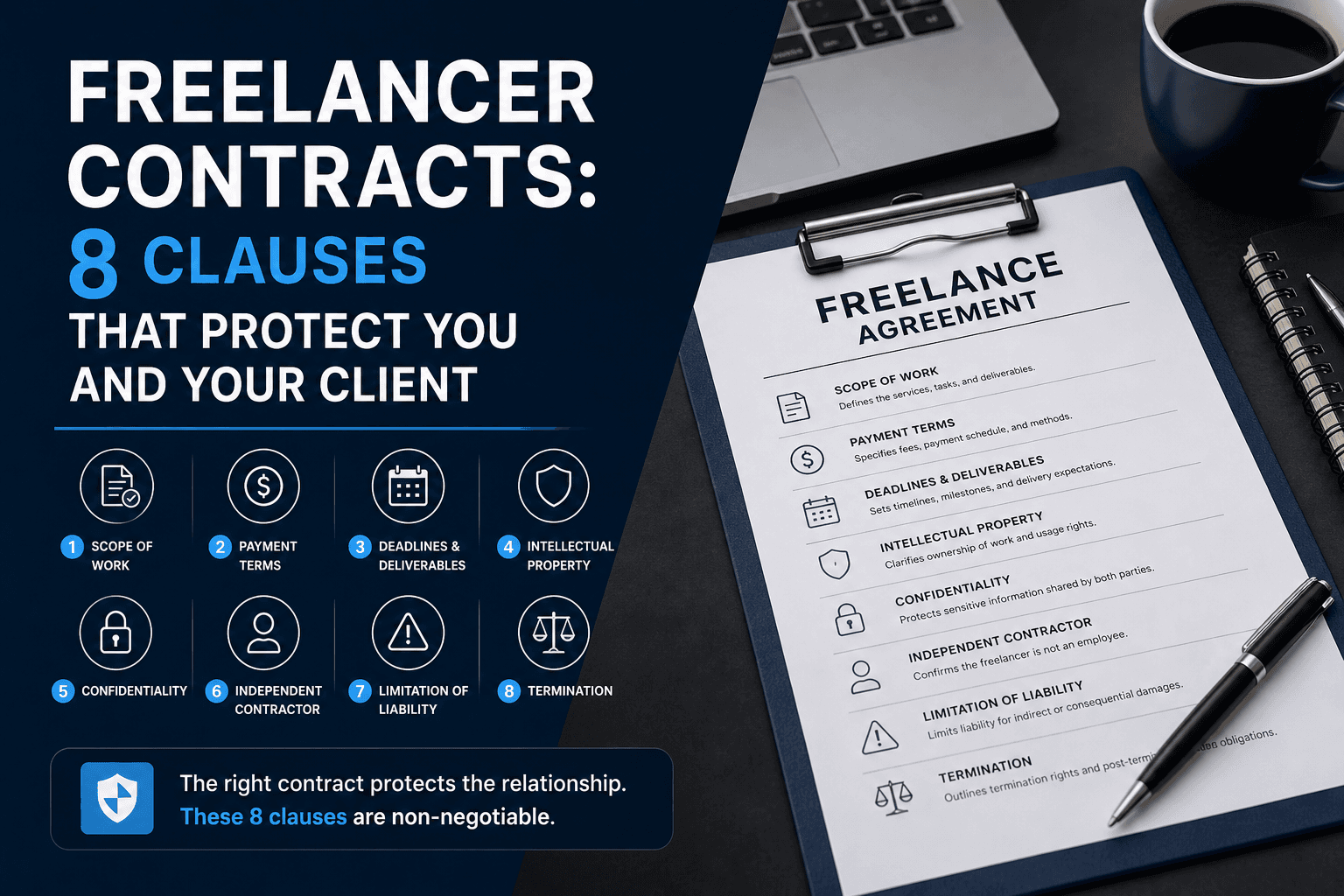
Freelancers and the clients who hire them both get burned by missing contract clauses. These 8 provisions are non-negotiable — and most freelance agreements are missing at least three of them.
The Contract You Write Before the Work Starts Determines the Dispute You Avoid Later
Freelancing is now a mainstream way to work — and hire. But the legal framework around freelance relationships is frequently misunderstood by both sides.
The client thinks the freelancer is "basically an employee." The freelancer thinks a quoted price covers everything. Neither assumption is written down. When something goes wrong — a missed deadline, an ownership dispute, an unpaid invoice — there is no contract to resolve it.
This guide covers the 8 clauses that every freelance agreement must contain, and explains why each one protects both parties.
Clause 1: Scope of Work and Deliverables
This is the most frequently disputed clause — and the most frequently vague.
A strong scope of work defines:
Without a precise scope, clients add tasks ("can you also just quickly..."), deadlines slip, and disputes about what was agreed become impossible to resolve.
The golden rule: If it is not in the scope, it is not in the price.
Clause 2: Fees, Payment Schedule and Late Payment
Vague payment terms are the leading cause of unpaid invoices in freelance work.
Your contract must specify:
Never start a project without a deposit. Never deliver the final file before the final payment.
Clause 3: Timeline and Milestones
Both parties need clarity on when things happen.
Define:
A client review deadline clause is the one freelancers most commonly forget. Without it, clients can sit on feedback for months while the freelancer is contractually on the hook for delivery.
Clause 4: Intellectual Property Ownership
Who owns the work? This is the clause that causes the most serious and costly disputes.
The default legal position in most jurisdictions (including Cyprus and the UK) is that intellectual property created by a freelancer belongs to the freelancer — unless the contract explicitly transfers ownership to the client.
Your contract must state clearly:
For software developers: specify whether open-source components are used and under what licences. For designers: clarify whether source files (PSD, Figma, AI) are included in the deliverable or cost extra.
Clause 5: Freelancer Status and Independence
This clause protects the freelancer from being reclassified as an employee — which would create significant tax and legal consequences for the client.
The contract must clearly establish that:
UK-specific note: If your contract relationship could be caught by IR35 (off-payroll working rules), this clause becomes critically important. HMRC looks at actual working practices, not just contract wording — but a well-drafted status clause is the starting point for any IR35 defence.
Cyprus note: The tax and social insurance treatment of self-employed contractors in Cyprus is distinct from employment. Misclassification can result in backdated social insurance contributions from the client.
Clause 6: Confidentiality
Freelancers routinely access sensitive business information: unreleased products, client lists, financial data, internal systems.
A confidentiality clause must cover:
For particularly sensitive engagements, a standalone NDA may be more appropriate than a confidentiality clause within the main contract.
Clause 7: Limitation of Liability
Without this clause, a freelancer could theoretically be liable for unlimited damages arising from their work — including consequential losses that dwarf the original project fee.
Your contract should:
Clients will sometimes push back on this clause. A reasonable negotiated position is to cap liability at 2x the project value — not unlimited.
Clause 8: Termination and Kill Fee
Projects get cancelled. Clients change their minds. Markets shift. Your contract must address what happens when a project ends early.
Define:
Without a kill fee clause, a client can cancel a project the day before final delivery, refuse to pay for completed work, and leave you with nothing but a breach of contract claim.
The Contract Both Parties Should Want
A well-drafted freelance contract is not adversarial. It is a shared agreement that removes ambiguity and lets both parties focus on the work. Disputes almost always arise from things that were never written down.
The 8 clauses above protect freelancers from non-payment and unlimited liability. They protect clients from scope creep, IP disputes, and contractor misclassification.
Need a freelance contract drafted or reviewed? Our legal team produces freelance agreements that protect both parties — tailored to your specific type of work, industry, and jurisdiction. Ready in 24-48 hours.
Need Legal Documents?
Get expert-drafted legal documents customized for your business. From NDAs to GDPR policies, we've got you covered.